
What is the importance of theatre in school education? In a global environment shaped by digitalisation, the Casvi Villaviciosa International School champions the performing arts as a cornerstone of the International Baccalaureate (IB) . Theatre is not merely an extracurricular activity. It is also a fundamental tool for developing public speaking skills, emotional intelligence and critical thinking. All of this prepares students for the challenges of their future careers.
THE CHALLENGE OF LIFELONG LEARNING
In an increasingly digitalised and automated global environment, many parents are wondering whether traditional academic education is enough. There is growing concern about the lack of soft skills (soft skills) among young people. Often, the conventional curriculum prioritises rote learning.
This leaves a gap in the development of emotional intelligence and personal expression. Many wonder whether pupils know how to communicate effectively or whether they are able to manage their fear of making mistakes. Therefore, understanding the importance of theatre in school education is key to rounding off their academic education.
THE CONSEQUENCES OF EXPRESSIVE INVISIBILITY
Neglecting the development of performing arts during school years puts pupils at a competitive disadvantage. A pupil who fails to develop their public speaking skills or creative thinking today will struggle to lead teams tomorrow.
Self-confidence is built at school; it cannot be improvised at university. Within the framework of International Education, a lack of these skills limits a student’s prospects at the world’s most prestigious universities. This is where we truly see the importance of theatre in school education as a distinguishing factor for success.
WHAT IS THE IMPORTANCE OF SCHOOL THEATRE IN THE INTERNATIONAL BACCALAUREATE?
School theatre is not merely a form of entertainment, but a fundamental pillar of education. Under the rigorous framework of the International Baccalaureate (IB), the performing arts become a laboratory for inquiry. When analysing the importance of theatre in school education, the following benefits stand out:
- Development of critical thinking: Character analysis encourages students to question reality and understand different perspectives.
- Authentic and contextual bilingualism: Enables the practice of another language in various emotional contexts, reinforcing the vocabulary in an organic way.
- Managing emotional intelligence: Taking to the stage requires self-control and teamwork. This helps improve performance in subjects such as Maths or Science.
- Public speaking and stage presence: The ability to structure a speech and maintain eye contact is a powerful tool that theatre naturally provides.
THE DRAMA SCHOOL OF CASVI VILLAVICIOSA AS A PLATFORM FOR SUCCESS
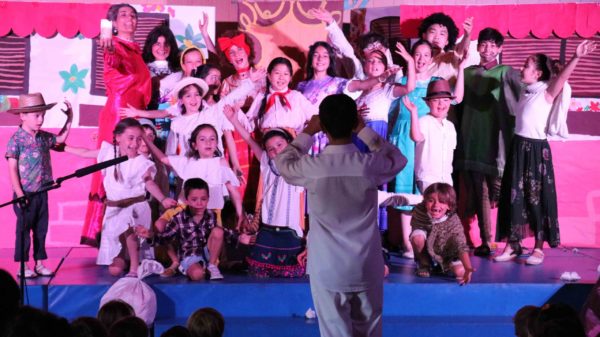
At the Casvi Villaviciosa International School, theatre comes to life through our Drama School. This programme is a high-calibre development platform that delivers tangible results:
1. PERFORMING ARTS AND FESTIVALS
Nuestros alumnos se preparan para el escenario real. La participación en certámenes y concursos de teatro y oratoria fomenta la superación. Estas experiencias enseñan a trabajar bajo estándares de calidad profesional y refuerzan la resiliencia ante el juicio del público.
2. MAJOR PROJECTS: THE FINAL PROJECT AS THE GOAL
Every year, the school stages significant plays. The pupils experience the entire production process, from acting to dramatic storytelling. These performances celebrate the talent and dedication of our entire school community.
3. Link to CASVI’s values and the IB
The School is aligned with the Profile of the IB Student IB, demonstrating the importance of theatre in school education:
- Open-mindedness: When portraying characters from various cultures and eras.
- Confidence: When representing the school at external competitions and public events.
- Reflection: Analysing one’s own performance to identify areas for improvement.
“Theatre is poetry that steps out of the book to become human.”
WHAT IS THE IMPORTANCE OF THEATRE IN SCHOOL EDUCATION FOR CASVI VILLAVICIOSA?
Theatre plays a very significant role in education. At Casvi Villaviciosa, the Drama School is a meeting place for students with an interest in the arts. Here, friendships are forged based on respect and technical collaboration, enhancing emotional well-being. At Casvi, the stage is where hard work turns into applause.
FREQUENTLY ASKED QUESTIONS
How does theatre foster creativity in schools?
Theatre acts as a catalyst for divergent creativity. As there is no single ‘correct answer’, pupils at Casvi Villaviciosa School, for example, explore a range of solutions. Improvisation fosters the generation of ideas under pressure, a key skill in the IB approach that encourages bold thinking.
What benefits does theatre offer in terms of values education and moral education?
It provides a solid ethical foundation. By embodying characters facing dilemmas, students ‘experience’ these values first-hand. In our international education setting, this helps to shape students of integrity and reflective character.
How does theatre promote inclusion and diversity?
The theatre is a place of open-mindedness. It breaks down social hierarchies: on stage, every role is vital. It promotes inclusion by giving a voice to different perspectives, turning diversity into a tool for collaborative learning.
What skills are developed through theatre activities?
A set of soft skills has been developed to explain the importance of theatre in school education:
- Cognitive skills: Memory, text analysis and critical thinking.
- Physical: Postural control, spatial awareness and bilingual diction.
- Social skills: Assertiveness, leadership and active listening.
To what extent does theatre promote concentration and discipline?
Theatre demands complete concentration. A mistake at the start affects the whole group; consequently, it requires strict discipline. Students learn that excellence is the result of perseverance and rigorous rehearsal.
How does theatre improve communication and teamwork?
Theatre demands complete concentration. A mistake at the start affects the whole group; consequently, it requires strict discipline. Students learn that excellence is the result of perseverance and rigorous rehearsal.
How does help teatre develop problem-solving skills?
It is a training session in crisis management. If an item from the props goes missing, the student must resolve it in real time. This ability to maintain calm is one of the reasons for why the importance of theatre in school education for future leadership.
What does theatre contribute to emotional education and intelligence?
It is the ultimate setting for self-regulation. Theatre allows students to explore their emotions in a safe environment. By identifying their character’s emotions, students learn to manage their own, which helps prevent school-related stress.