

In today’s technological landscape, many parents watch with concern as their children spend hours in front of screens. The question that arises at family gatherings and parent-teacher meetings is a pressing one: are children acquiring valuable skills or simply consuming content passively? The fear that technology will ‘stifle’ critical thinking in the younger generation and fail to foster computational thinking is a real concern, rooted in the gap between usage playful and understanding logical.
THE RISK OF "DIGITAL BLINDNESS"
Failing to understand the logic behind a screen creates dependent citizens. If a child does not develop the ability to sequence, think abstractly and solve problems, they will face a competitive disadvantage in thelabour market. The World Economic Forum, prioritises analytical thinking over any other skill.
In this sense, the International School Casvi Villaviciosa points out that the real “digital divide” is not access to the devices. It is the ability to control them. Without it computational thinking, children are merely passengers in a vehicle they do not know how to drive. Theroot of the problem with this issue lies in the fact that, by the time when they arrive at university, las bases cognitivas de la resolución de problemas ya deberían estar consolidadas. De esta manera, podrán colaborar con inteligencias artificiales de forma efectiva.

A MENTAL FRAMEWORK FOR THE 21ST CENTURY

Computational thinking is a problem-solving methodology that goes beyond computer science. Essentially, it involves learning to think in a systematic way in order to find solutions that can be applied to any area of life.
As Dr Jeannette Wing clearly defines in her influential study Computational Thinking: What and Why?, it is a process of modern literacy that all children should master
THE 4 KEY COMPONENTS AND THEIR EDUCATIONAL APPLICATION
For learning to be effective, we need to focus on four key areas:
- Breakdown: Teaching students to break down a major challenge (such as organising an event or solving a maths problem) into smaller, manageable tasks.
- Reconocimiento de patrones: The ability to identify patterns. This is the foundation of prediction and efficiency.
- Abstract: Identify what is essential and eliminate the ‘noise’. According to the MIT Media Lab, this is the key skill for managing today’s information overload.
- Algorithm Design: Create step-by-step instructions. It’s not just about code; it’s about knowing how to give clear and logical instructions.
“Computational thinking is the thought process involved in formulating problems and their solutions.”
IMPACT ON CHILD DEVELOPMENT
- Improvements in early literacy: Tufts University has shown that children who work with robotics and computational thinking improve their skills in sequencing. This is is directly related to reading comprehension.
- Preparing for AI: By 2026, understanding computational thinking will be a prerequisite for carrying out prompt engineering and collaborating with artificial intelligence in an ethical and effective manner.
- Resilience in the face of mistakes: Students are taught that a mistake is a “bug” that can be corrected, thereby eliminating the frustration associated with traditional academic failure.
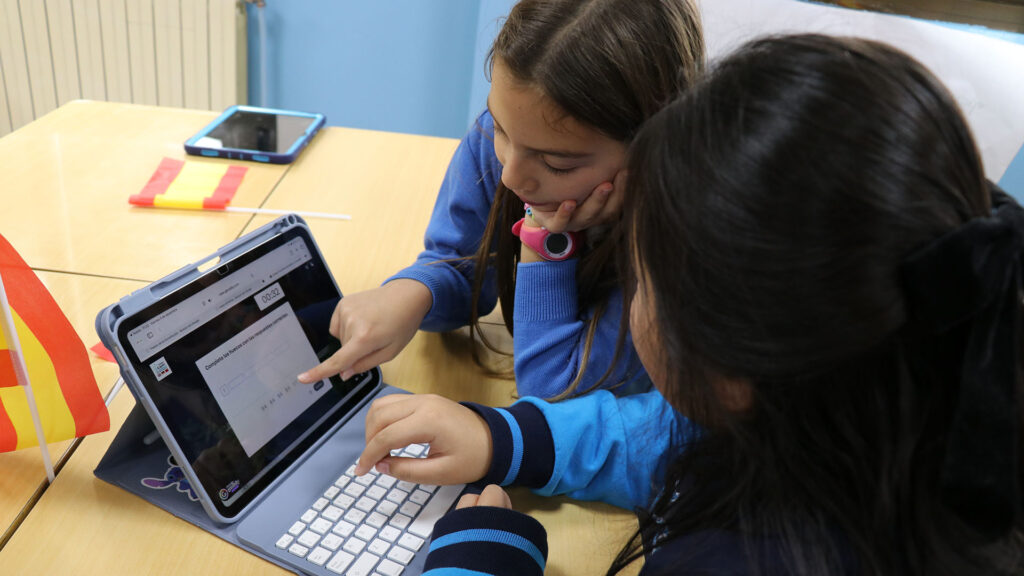
TIPS FOR ENCOURAGING COMPUTATIONAL THINKING AT HOME
- Cooking as a family: Following and adapting a recipe is the purest algorithm there is.
- Juegos de mesa: Títulos que impliquen planificación (como el ajedrez o juegos de estrategia moderna) refuerzan el reconocimiento de patrones.
- Visual programming: Tools such as Scratch (developed by MIT) enable children as young as from the age of 8 to create stories using logical blocks.
THE CASVI VILLAVICIOSA MODEL AS A BENCHMARK
The practical implementation of these concepts requires a suitable infrastructure and a teaching mindset that is ready for the task. The Casvi Villaviciosa International School applies this approach through the International Baccalaureate Programme Continuum (IB).
At this centre, the concept of computational thinking It is not confined to Technology lessons. It is evident in the science laboratories, in robotics projects and in everyday inquiry. By equipping pupils with these tools, the school ensures that they not only use the technology, but rather that they take the lead. In this way, they turn the initial concern of the parents, into the assurance of an elite education for the future.
FREQUENTLY ASKED QUESTIONS ABOUT COMPUTATIONAL THINKING
What is the relationship between computational thinking and creativity?
Computational thinking and creativity feed into one another. This methodology provides a logical framework that enables abstract ideas to be put into practice and turned into real-world solutions. By understanding how systems work, students can innovate and create original projects with a solid technical foundation.
How does computational thinking influence analytical skills?
Computational thinking enhances analytical skills by teaching students to break down complex problems into smaller parts (decomposition). This enables us to identify which elements are critical and which are irrelevant, facilitating a deep and objective understanding of any situation.
How is computational thinking linked to problem-solving in a team?
Promotes efficient collaboration through the modularity. The computational thinking It enables each team member to work on a specific part of the problem (modules) in a coordinated manner. This ensures that all the pieces fit together seamlessly in the final solution.
How can computational thinking improve productivity at work?
Productivity is improved by applying algorithmisation. Identifying repetitive tasks and designing logical workflows helps to optimise time and reduce human error. This is a skill that the Casvi Villaviciosa International School considers this essential for a student’s future career.
What is the importance of computational thinking in the digital age?
In 2026, computational thinking is the foundation of digital literacy. It is essential for interacting with the Artificial Intelligence and understanding the algorithms that govern today’s society, enabling the transition from being a user passive to a creator of technology critical.
How can computational thinking improve long-term planning skills?
Enables the simulation of scenarios. Through the use of sequential logic, computational thinking helps to anticipate possible obstacles and outcomes future, establishing a roadmap for roadmap clear and efficient for achieving goals far away.
How can computational thinking improve decision-making?
It reduces subjectivity by basing decisions on data and logical processes. The computational thinking trains the mind to evaluate variables and conditions, which leads to more informed decisions, consistent and easy to correct through “debugging” or debugging.
Why is it important to teach computational thinking?
It is vital because it provides children with a key tool that cuts across all areas of problem-solving of problems. Teaching computational thinking ensures that pupils develop the independence, resilience and analytical skills necessary to succeed in any career in the 21st century.