
During the early years of life, language is the foundation upon which thinking, communication and learning are built. However, it is common for many families to wonder whether their children’s language development is progressing at the expected rate: whether they are pronouncing words correctly, expanding their vocabulary, understanding what they hear, or whether they will have difficulties reading or learning languages later on.
So, what is the relationship between music and language development in children? In this context, music is often perceived as a recreational or artistic activity. Rarely is it seen for what it really is: a powerful neurological stimulus directly related to language development.
A BRAIN WINDOW THAT DOES NOT REPEAT ITSELF
The neuroscience of child development is clear: the early years of life—especially between the ages of 0 and 6—are a critical stage for language development. During this period, the brain is particularly sensitive to sound, rhythm and melody.
When this stimulation is poor, passive or lacking in variety, key skills such as sound discrimination, phonological awareness and verbal memory can be affected. All of these are essential for literacy and language learning.
This is not about causing alarm, but rather understanding a fundamental educational reality. That the sound environment matters, and music can be a decisive ally… But also a missed opportunity.
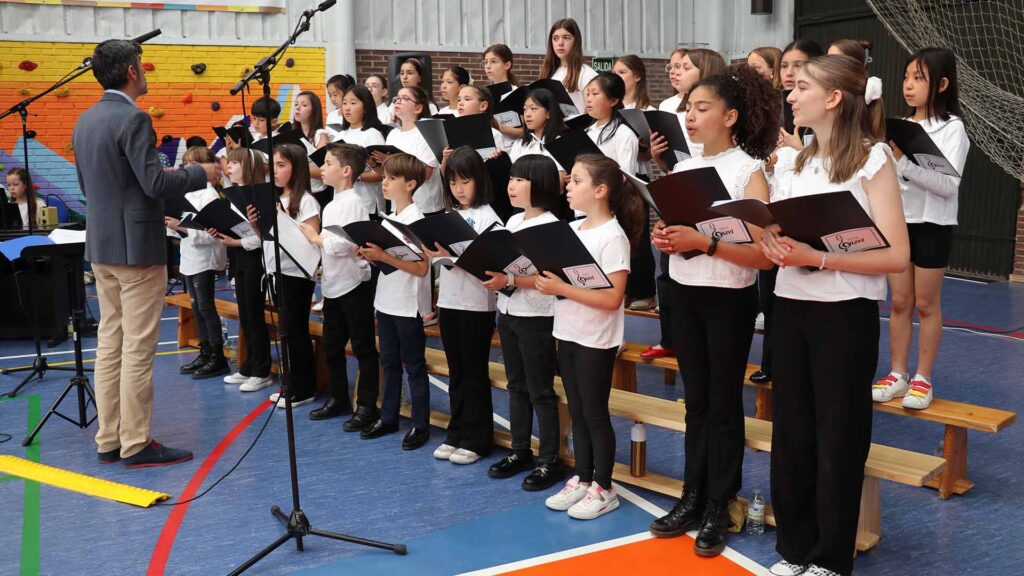
MÚSICA Y LENGUAJE: UNA CONEXIÓN CEREBRAL DEMOSTRADA
From educational and psycho-pedagogical experience, and backed by research in neuroeducation, we know the relationship between music and language development in children. Music and language share common neural networks. Both processes activate areas related to rhythm, intonation, sequencing, auditory attention, and memory.
When a child sings, follows a rhythm or participates in a musical activity, they are not only having fun: they are training the same system that they use to speak and understand.
What language skills are stimulated through music?
Early and active musical practice directly promotes:
- Phonological awareness phonological, the basis of learning to read
- Pronunciation and articulation, thanks to rhythmic repetition
- Verbal and auditory memory, necessary for constructing sentences
- Intonation and prosody, essential for oral comprehension
- Spontaneous oral expression, reducing inhibition and fear of making mistakes
That is why singing is not a complement: it is language in action.
Music active vs. music passive: a key difference
Not all musical stimuli have the same impact. The real benefits appear when the child:
- Sing, move or accompany with gestures
- Take part in musical storytelling or dramatisations
- Repeats rhythmic and melodic structures
- Experience music as a shared experience
Listening to music in the background can be pleasant but but active participation is what transforms linguistic development.
Music and learning of languages
Music also prepares the brain for foreign language learning. Listening to and reproducing sounds in different languages improves auditory discrimination and cognitive flexibility. As a result, it facilitates more natural language acquisition in bilingual or multilingual contexts.
Music education at Casvi Villaviciosa does not only seek to train performers. It also aims to produce individuals who are capable of expressing themselves creatively and of understanding the world from different perspectives. a13> understand the world from different perspectives. This facilitates the development of the discipline and skills such as collaborative work and active listening”.
WHEN MUSIC BECOMES EDUCATION: THE CASVI VILLAVICIOSA MODEL
At Casvi Villaviciosa International School, music is not an isolated subject or a one-off activity. It forms part of the educational project from an early age. From Early Childhood Education it is integrated as a tool for language development, oral expression and communicative confidence.
From their daily classroom practice, the teaching and educational psychology team has observed that activities such as narrative songs, musical stories, body rhythms, dramatisations, and working in different languages bring great benefits. Ultimately, what is the relationship between music and language development in children?
- Improve pronunciation
- Expand your vocabulary
- And they promote more confident and fluent oral expression.
This approach does not seek immediate or spectacular results. It aims for solid, natural linguistic development adapted to each child’s pace. This is reinforced if you wish to continue working on this discipline outside school hours, within the Casvi Music School.
👉 Discover how we integrate music and language into our educational project.
QUESTIONS FREQUENTLY ASKED ABOUT WHAT IS THE RELATIONSHIP BETWEEN MUSCULATURE AND DEVELOPMENT OF LANGUAGE IN CHILDREN?
Can music in the home have a positive impact on the language of children?
Yes. Singing together, repeating songs and accompanying them with gestures reinforces vocabulary, pronunciation and verbal memory, especially at an early age.
Do musical stories help improve language skills?
They are particularly effective because they combine emotion, narrative and rhythm, facilitating comprehension and oral expression.
Does music in different languages influence language development?
Yes. Listening to songs in different languages improves sound discrimination and facilitates subsequent language learning.
Can music prevent language problems?
It does not replace specialised intervention, but acts as a preventive factor, stimulating key skills and facilitating early detection.
Is classical music superior to other genres?
More than the style, what is important is the musical structure and the active interaction of the child with the music.
Does learning an instrument improve language development?
Various studies indicate improvements in auditory memory, attention and sequencing, skills directly related to language and literacy.
| Criteria | Casvi Villaviciosa | Villalkor | Ágora | SEK |
|---|---|---|---|---|
|
Integration into the curriculum |
Subject integrated into the International Baccalaureate (IB) programme continuum. |
Focus on national curriculum with music as a standard subject, without the depth of inquiry found in the IB. |
Although they offer the IB, their musical approach tends to be more closely linked to their private conservatory than to everyday classroom life across the board. |
Focused on technical execution and preparation for external examinations, with less integration into the student’s profile. |
|
Organisational structure |
Our own music school with professional and specialised monitoring from an early age. |
Offer of music mainly as an extracurricular activity complementary to the school curriculum. |
It has a conservatory, but as an entity external to the school’s regular academic programme. |
Music school with a traditional approach, less involved in institutional innovation projects. |
|
Methodology and values |
Promotes attributes such as being bold, communicative and thoughtful through the interpretation and creation. |
Guidance more academic and theoretical, following the outlines of traditional education . |
Methodology focused on technical musical excellence, but with less emphasis on the transdisciplinary nature of the IB. |
Prioritise instrumental learning over the development of soft skills and an international mindset. |
|
Events and impact |
High visibility at institutional events and business meetings, linking talent and a culture of hard work.
|
Participation in local events, but with less institutional and external relations significance.
|
Internal and conservatory events, with a less clear connection to the institutional fabric of the centre.
|
School festivals and concerts with a more playful and less strategic approach.
|
|
Use of technology |
Students trained in audiovisual design and editing (Adobe, Canva) for modern music production. |
Limited use of advanced music technology integrated into the compulsory curriculum. |
Focus on classical instruments with less emphasis on digital editing for the average student. |
Standard equipment, without such a marked strategy for digitising musical content. |