
Admission to university is one of the most significant milestones in any student’s academic journey. Furthermore, it requires preparation that goes beyond simply achieving a numerical grade. At the Casvi Villaviciosa International School, the International Baccalaureate (IB) has established itself as the most robust route to university entry. A methodology based on the development of skills and intellectual maturity, designed for the most demanding universities in the world.
THE CHALLENGE OF THE PAU AND TRADITIONAL EDUCATION
In today’s educational landscape, the transition to higher education is a source of legitimate concern for families due to models that prioritise rote learning. The conventional system often boils down to one-off assessments that do not always reflect a student’s true potential. This makes it difficult to gain entry to university in highly competitive degree programmes.
THE ACADEMIC GAP AND THE RISK OF OBSOLESCENCE
The problem with traditional education does not end once a place has been secured. It also manifests itself in the ‘academic shock’ resulting from the lack of research skills.
Ignoring the importance of an active methodology can lead to a reduced capacity for analysis and render the skills acquired obsolete in the face of rapid technological change.
It is therefore an urgent strategic necessity to choose a path that ensures not only entry, but also successful retention through analytical thinking and resilience.
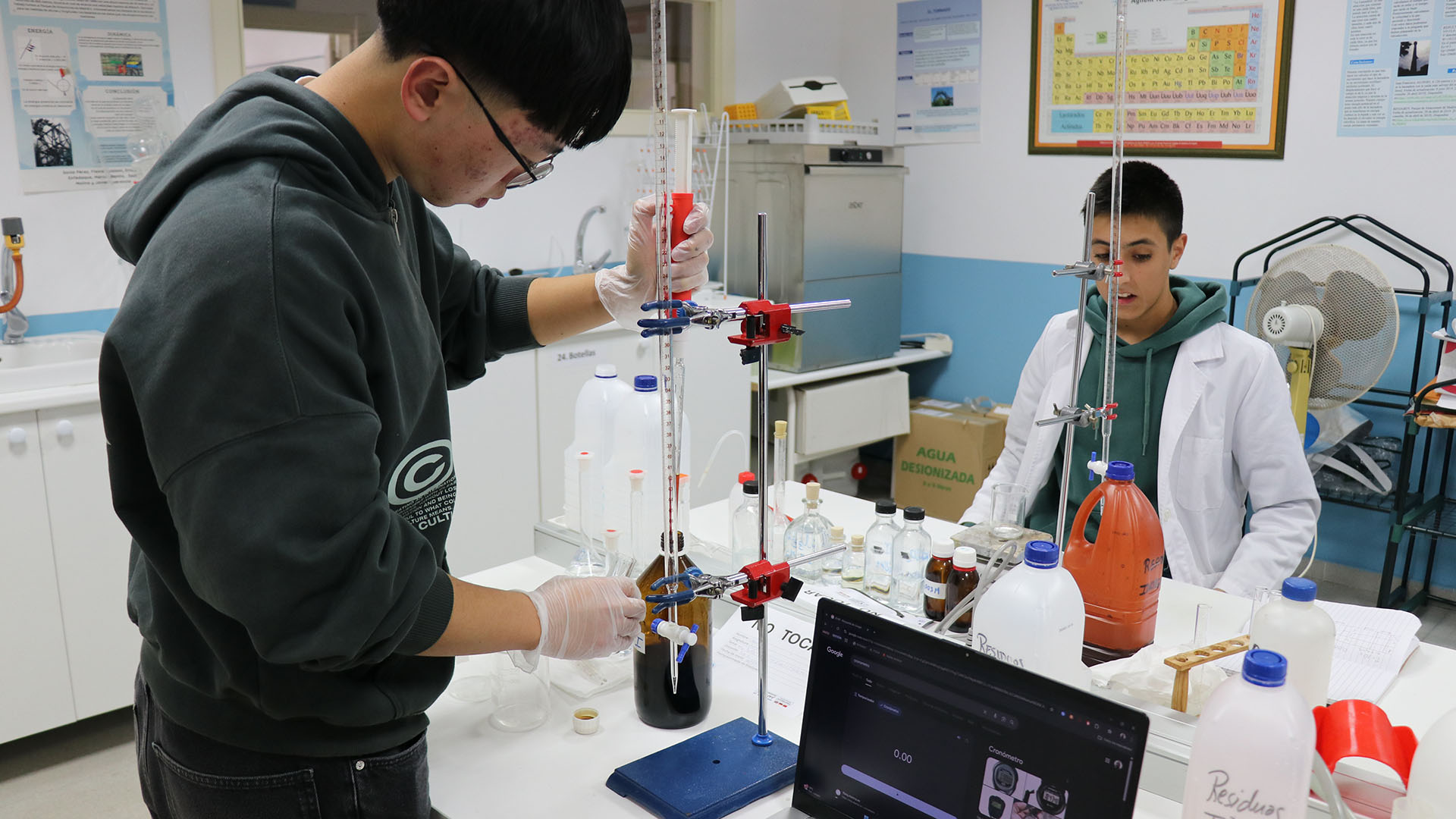
University entry via the International Baccalaureate: IB students conducting experiments.
At the Casvi Villaviciosa International School, university entry is seen as the natural outcome of a process of cognitive development integrated into the IB Programme Continuum. This methodology provides a distinct competitive advantage based on international standards:
- Global Recognition: The IB Diploma provides access to university at the world’s most prestigious institutions, such as the University of Oxford or the Stanford University, which value the rigour of this international curriculum.
- Direct entry in Spain: Thanks to reciprocal agreements and the framework of the International Baccalaureate, students can apply for direct entry into the national system through organisations such as UNEDasiss.
- Research skills: Before starting university, students have already carried out independent research and worked on real-world projects. In this way, they gain the autonomy needed to take the lead.
- Success stories: The centre’s track record is backed by 28 success stories from former students who are now leaders in their respective professional fields.
THE CORE COMPONENT: MONOGRAVÍA AND TDC AS REAL-LIFE SIMULATORS
A key aspect of this programme is how the requirements of the Diploma Programme act as a real-life university simulator. The subject of Theory of Knowledge (TOK) enables students to question reality and fosters critical thinking. The Extended Essay trains students in in-depth research and the connection of various areas of knowledge. These skills facilitate entry to university and ensure that graduates stand out for their analytical skills and critical thinking.
CASVI VILLAVICIOSA, A LEADING ORGANISATION IN UNIVERSITY ADMISSIONS
As a leading centre for innovation, the Casvi Villaviciosa International School offers comprehensive support to ensure the best possible access to university:
- Specialist guidance: We provide advice on choosing the subjects that carry the most weight for specific degree programmes and future careers.
- Active teaching methods: The focus is on inquiry-based learning and solving real-world problems, preparing students for changing work environments.
- Student Profile: We nurture critical, informed and digitally literate citizens who are able to adapt and innovate in any professional environment.
Now is the time to ensure your academic success. You can find out more about university entry and the Diploma Programme at Casvi Villaviciosa International School.
FREQUENTLY ASKED QUESTIONS ABOUT UNIVERSITY ADMISSION
Is a sixth-form qualification required to enter university?
Yes, for students in Spain, it is a basic academic requirement. However, the International Baccalaureate (IB) programme offers a globally recognised qualification pathway that simplifies this process.
How long does the university admissions process take?
The administrative process tends to take place between the months of May and July.
Is it possible to get into university without taking the A-levels?
Yes, the students of the IB can access directly via the validation of their diploma through organisations such as UNEDasiss, without the need to take the general stage of the PAU.
Which institutions are responsible for regulating access to university?
In Spain, regulation falls under the remit of the Ministry of Education and the autonomous communities, whilst the International Baccalaureate Organisation (IBO) and the UNED are involved in the international system.
How important are university entrance exam results when choosing a degree course?
This is crucial for securing a place on degree courses with an intake quota. At Casvi Villaviciosa International School, we strive to ensure that pupils develop the skills and qualities needed to choose their future career path freely.
What language requirements do I need to meet to get into university?
Depende del destino. Las universidades internacionales suelen exigir certificaciones oficiales. El modelo bilingüe de Casvi facilita que el alumno domine el idioma de forma orgánica y contextual antes del ingreso.
What is the minimum age for entry to university?
Usually at the age of 18, coinciding with the completion of the IB Diploma Programme, which prepares students to take on leadership roles in professional settings once they reach the age of majority.